Notes from Anthropic’s S-1 Filing as It Prepares to Go Public
Anthropic filed its S-1 registration statement with the SEC this week, a major step toward an initial public offering (IPO) that press reports say could come as soon as next month. Media also report that Anthropic, the company behind the popular Claude AI platform, is targeting a valuation of $1.5 trillion to $2 trillion.
Why an IPO Itself Shouldn’t Command Much Attention
I’m not one to spend time on IPOs, let alone take up others’ time reading about them. While any large company going public is news, an IPO itself shouldn’t command much time or attention. An IPO is just an initial offering: only a small percentage of a company’s shares are sold and traded when it goes public, and most investors can’t get them at what is typically a sandbagged IPO price. (The Wall Street firms underwriting the listing do everything they can to make sure the stock pops on day one and spares them embarrassment.) Those IPO allocations go mostly to large institutional investors that do business with the underwriters or that the underwriters are courting.
No matter. The initial pop is often fleeting, as those who got in at the IPO price flip their shares for a quick profit and the market turns its attention to all the shares still to come on a secondary basis. (The IPO is for just a small percentage—often 10–15%—of all the shares that will eventually trade in public markets.) Those secondary sales come from pre-IPO investors, including company executives and other insiders, typically once their lock-up period (the months after an IPO when insiders are barred from selling) expires.
Investors have plenty of time to get in. For the long-term investor who wants to own a company for compounded gains, whether they buy at the IPO, the day after, or a year after doesn’t matter much. It shouldn’t. And hot IPOs often offer better buying opportunities after the IPO, especially if they’re big or have had an easy time raising lots of money privately. (For these companies, going public is often as much about liquidity—cashing out—as about raising capital.) Facebook, Tesla, Snowflake and, recently, SpaceX come to mind as examples of the hottest IPOs of their time that later fell below their IPO price.
Why Read the S-1?
So why my note on the SpaceX IPO, and now this one on Anthropic? I actually read the S-1 filings for both. (An S-1 is the registration statement a U.S. company must file with the SEC before going public. It’s a formal declaration but, more importantly, a full disclosure to investors: the company’s financials, a description of the business, its risks, and other matters reasonably material to an investor.)
I read them not because I had any interest in the stocks or the IPOs, but because they are trillion-dollar enterprises going public (Saudi Aramco in 2019 is the only precedent), at the center of a generational technological shift, and part of what may be the largest gobbling up and deployment of capital in history.
The Macro Stakes: A Trillion-Dollar Build-Out
Like it or not, there are implications and far-reaching effects for what’s going on here. There are huge macro implications on the line as the hyperscalers (the giant cloud and platform companies: Amazon, Microsoft, Alphabet/Google, Meta) and the frontier AI labs (Anthropic, OpenAI and others) raise more debt and equity to build plant and equipment: data centers, chips, power—at a near $1 trillion a year clip (between, what, 10 companies?).
Some will keep losing billions of dollars a month for the foreseeable future. And none of them knows what kind of return they’ll get on their investment—or whether it’s all just corporate Highlander: “There can be only one.”
Anthropic and OpenAI (which has filed confidentially for its own IPO, reportedly at up to $1 trillion) are the leading frontier labs, but maybe the most vulnerable. Neither has a massively profitable business attached, as Alphabet/Google and Meta do. Then there’s Elon Musk and xAI, working toward a vertically integrated AI ecosystem flowing from data centers in space to everything else, including millions of humanoid robots.
If that’s not enough, there’s also China, with its cheaper power and a government in full support of its AI champions.
Connor MacLeod, the Highlander, had it easy by comparison: he had one Kurgan after his head. Anthropic has many.
Anthropic’s Business in Charts
(Derived from Its S-1 Filing)
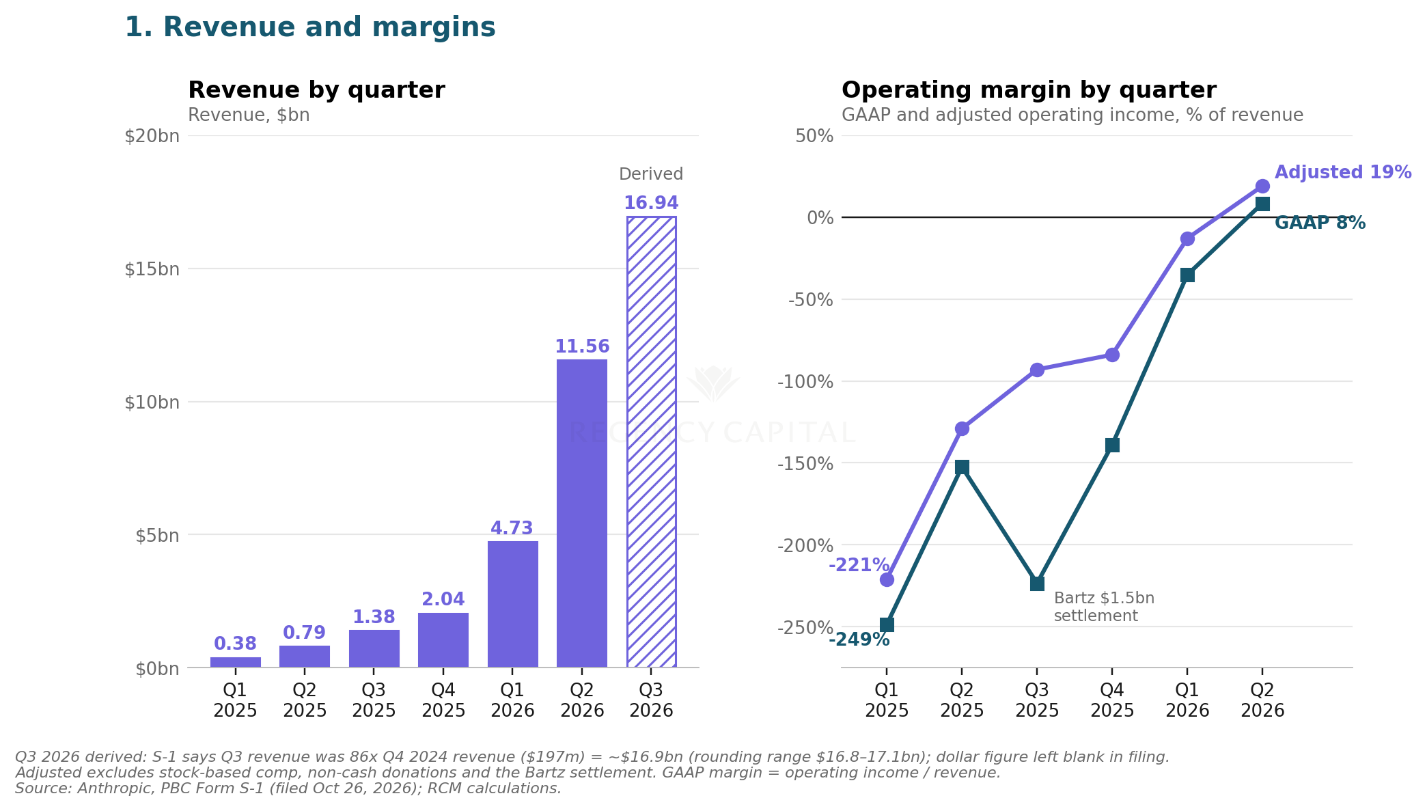
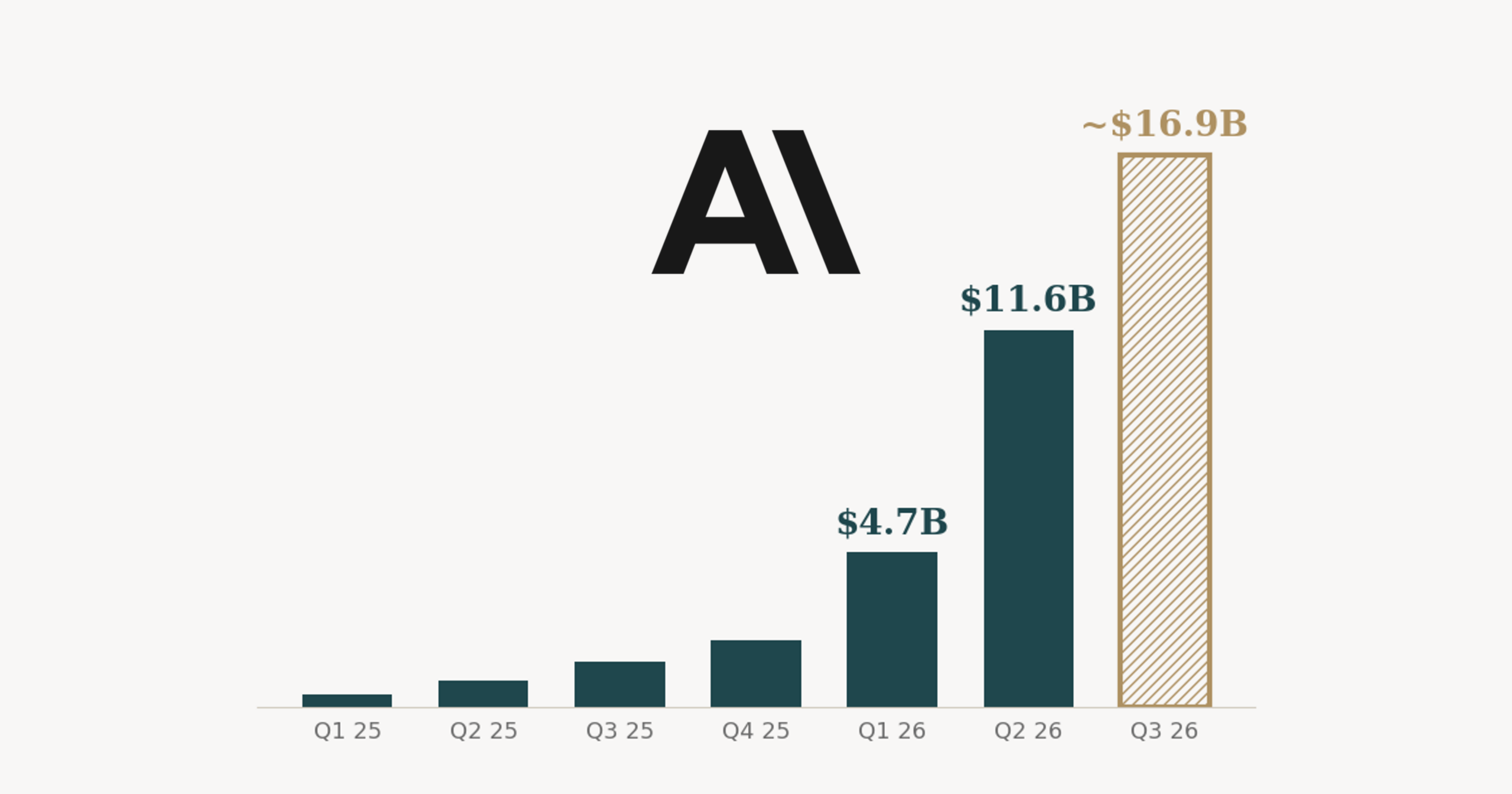
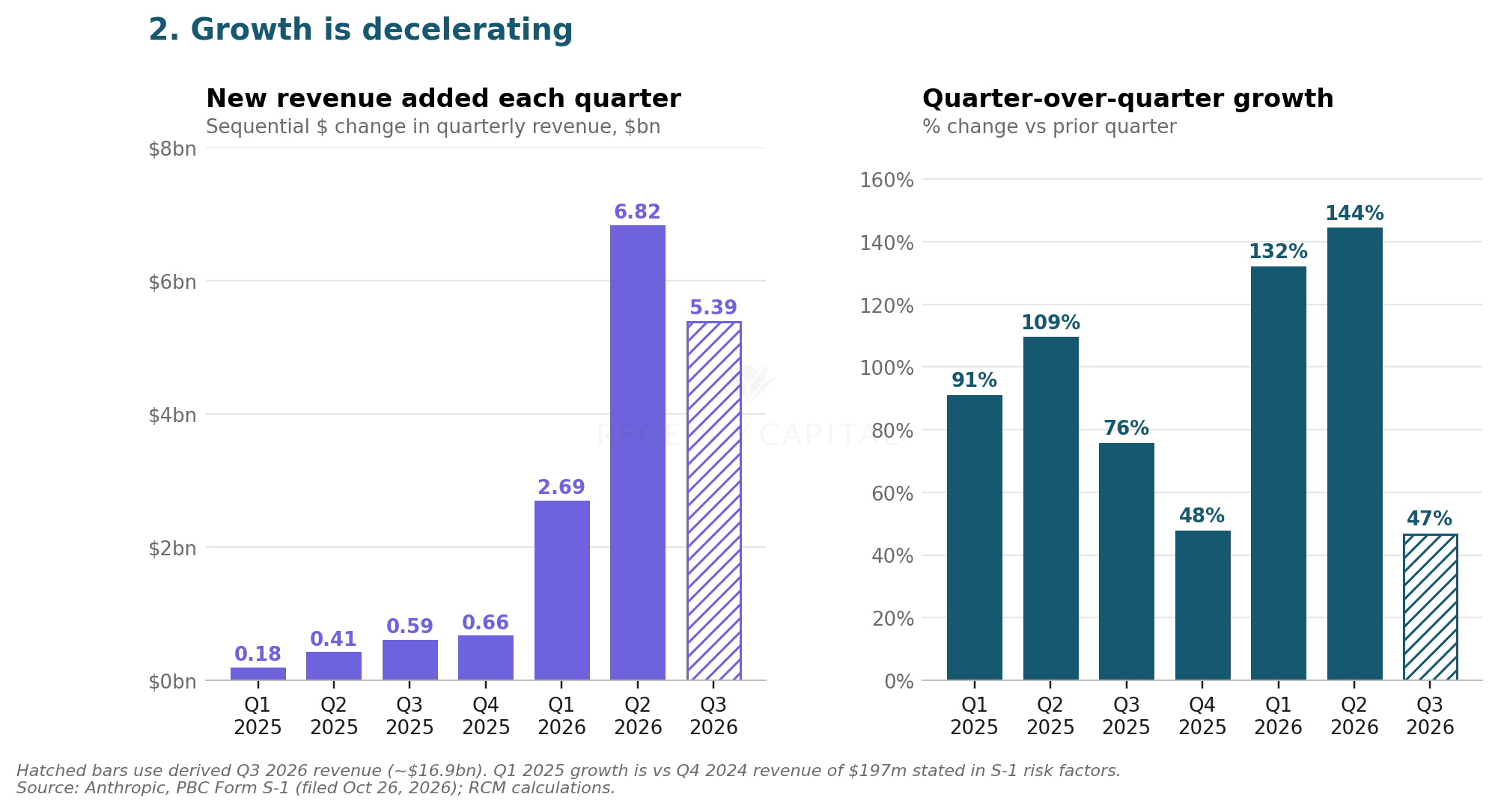
Anthropic is growing incredibly fast. Claude’s latest Fable and Opus models allowed Anthropic to overtake OpenAI’s (ChatGPT’s) initial lead. How long its lead lasts is anyone’s guess.
AI Isn’t Traditional Software
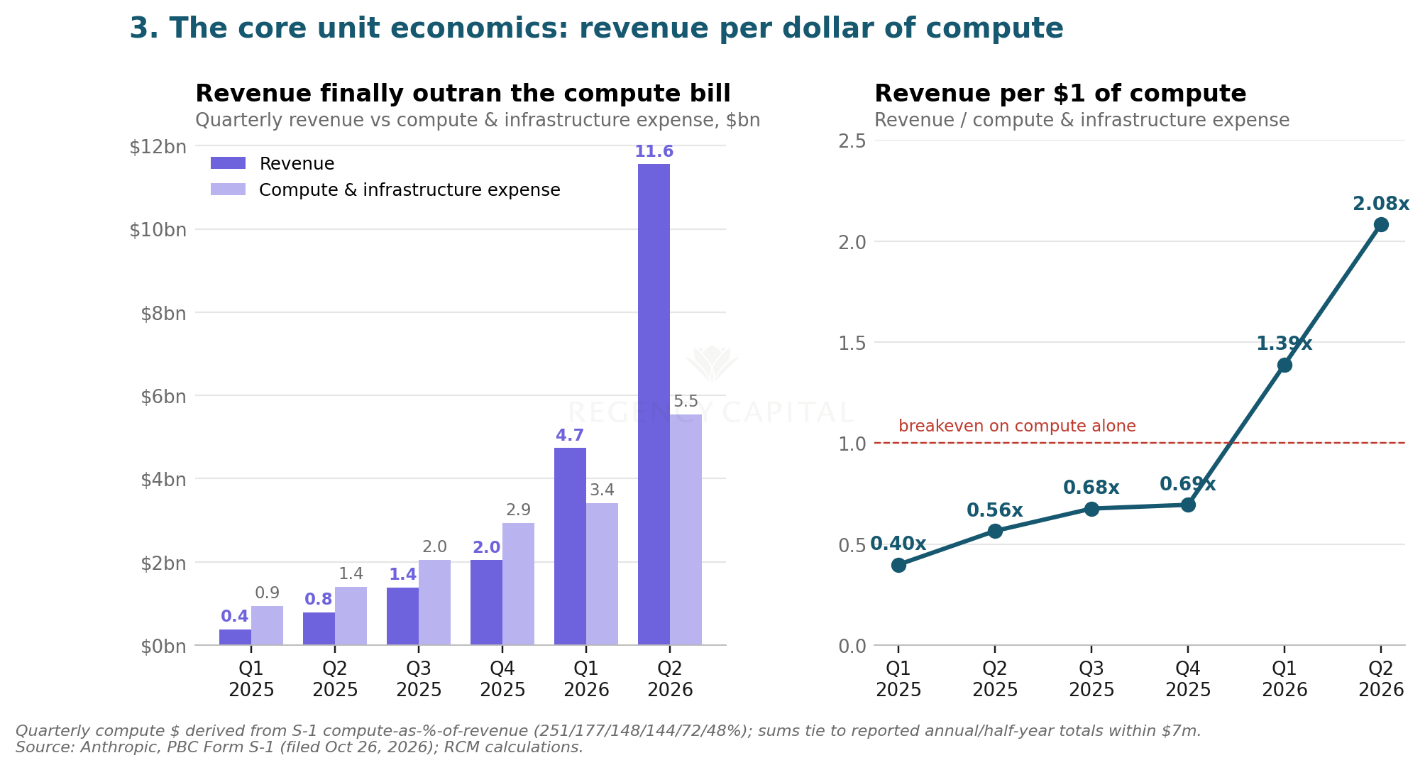
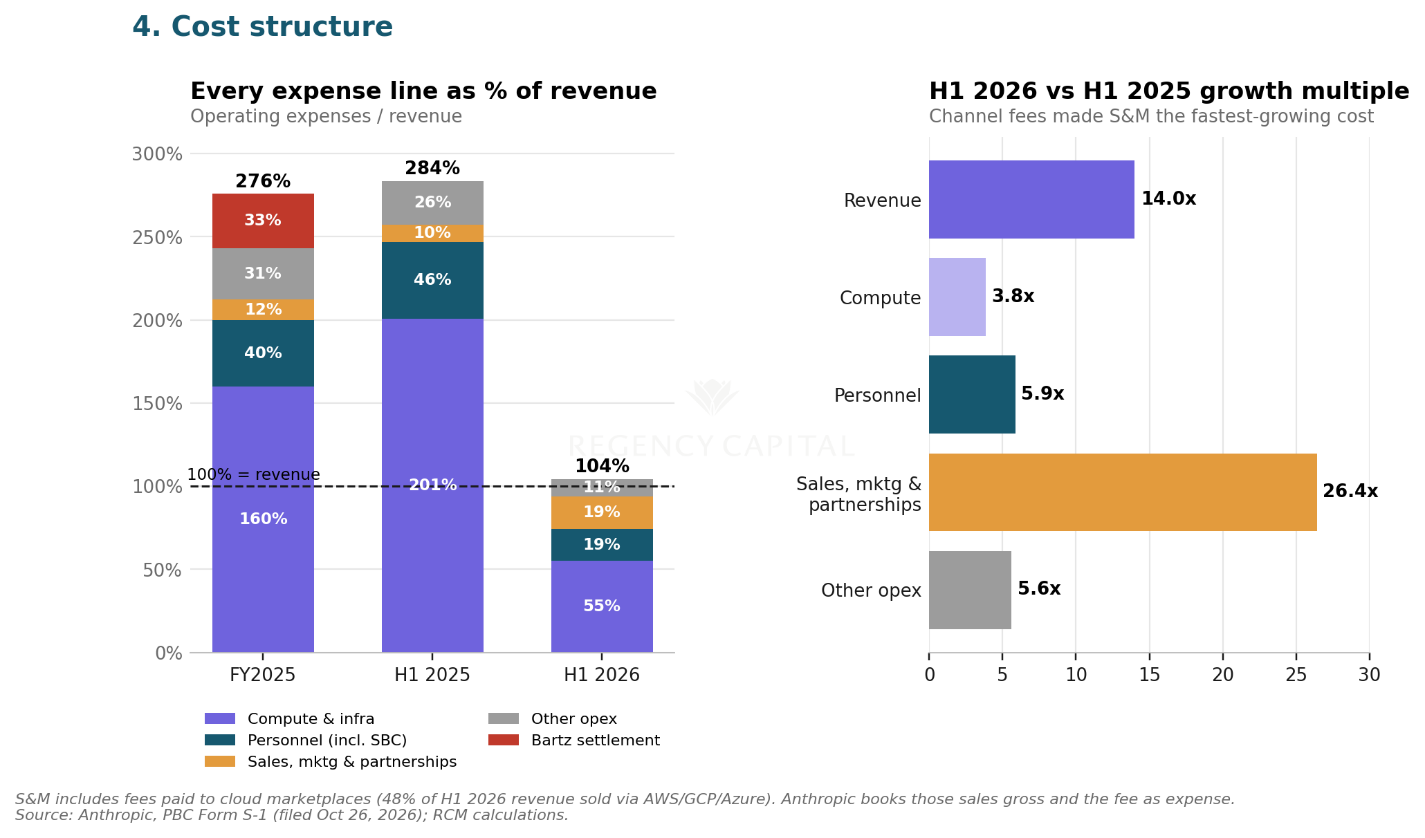
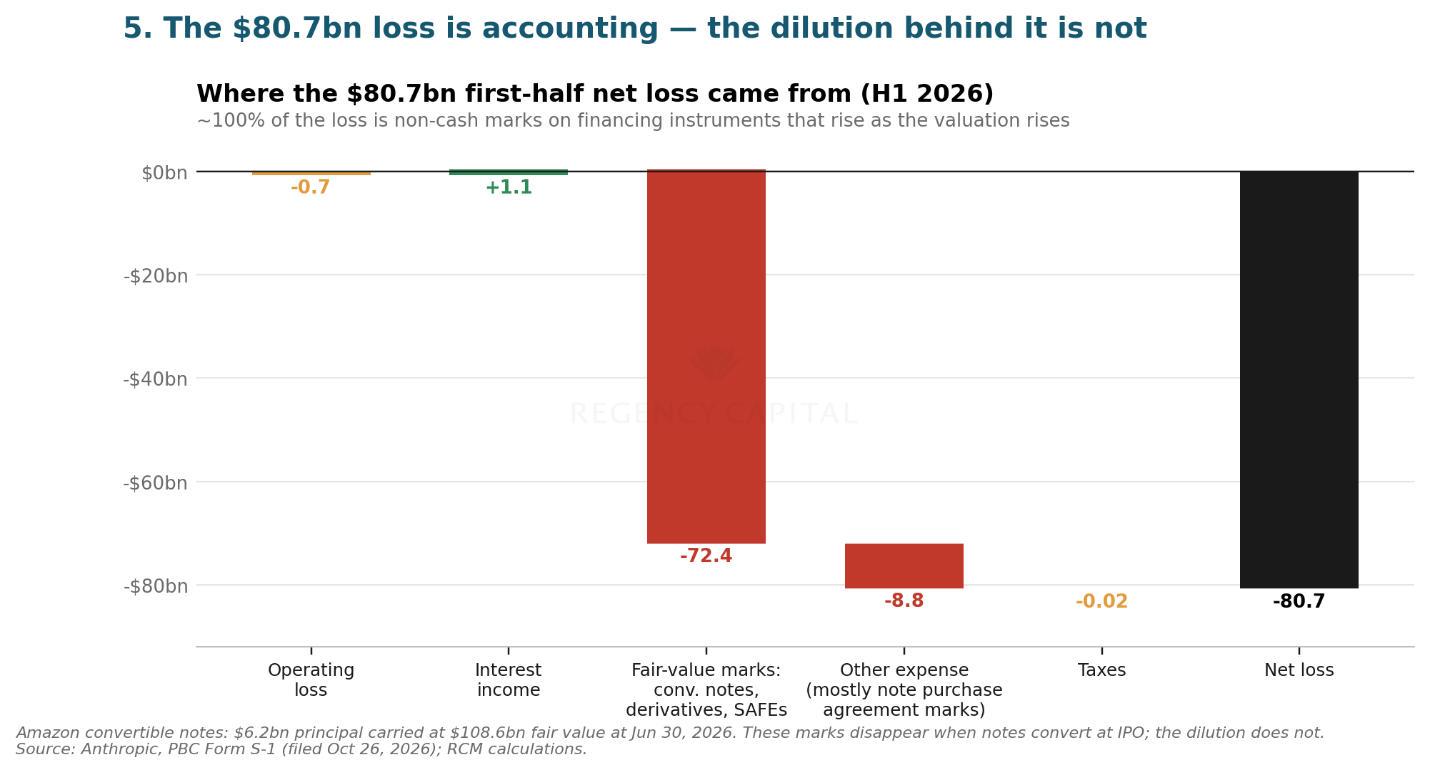
It should be pointed out that almost all of Anthropic’s $80.7 billion loss in the first half of this year was non-cash expense, but still, frontier AI labs have different cost structures than traditional software. Traditionally, software didn’t require huge up-front investments in data centers. It required little cost for maintenance and improvement. High margins could last and grow indefinitely. Today’s frontier AI labs also differ in that their product is never finished; they can’t build it once and have customers willing to pay indefinitely for access.
In AI, customers face no switching cost. They shift to the latest and greatest with ease. Anthropic’s S-1 touches on it: “…model versions released in the six months ended September 30, 2026 accounted for over 80% of our revenue [last quarter].”
This means last year’s shipment is already dead, economically speaking. All the competition and leap-frogging means pressure on what they can charge, little to no natural margin expansion like traditional software, and no customer loyalty. AI is not like software; it’s more like the auto business if people replaced their cars every six months.
What Would Justify a $1.5–2 Trillion Valuation?
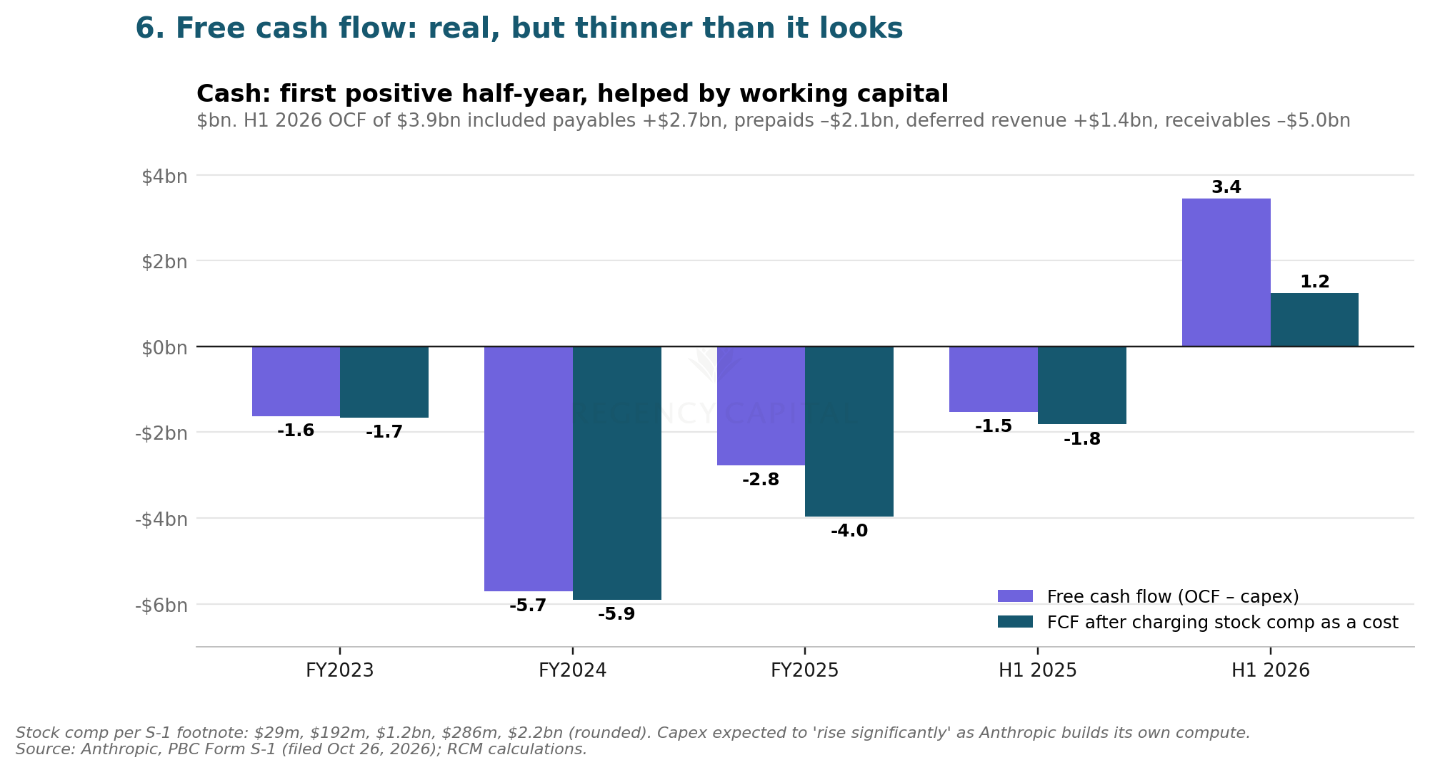
In the end, the real value of a company is only one thing: the sum of all its future cash flows to owners, discounted to the present. For Anthropic to justify a $1.5–2.0 trillion market cap, it will need to put up tens of billions a year in annual free cash flow (aka owners’ earnings). When it needs to achieve such levels of profits is for the market to decide. Right now, Mr. Market is clearly optimistic and patient.
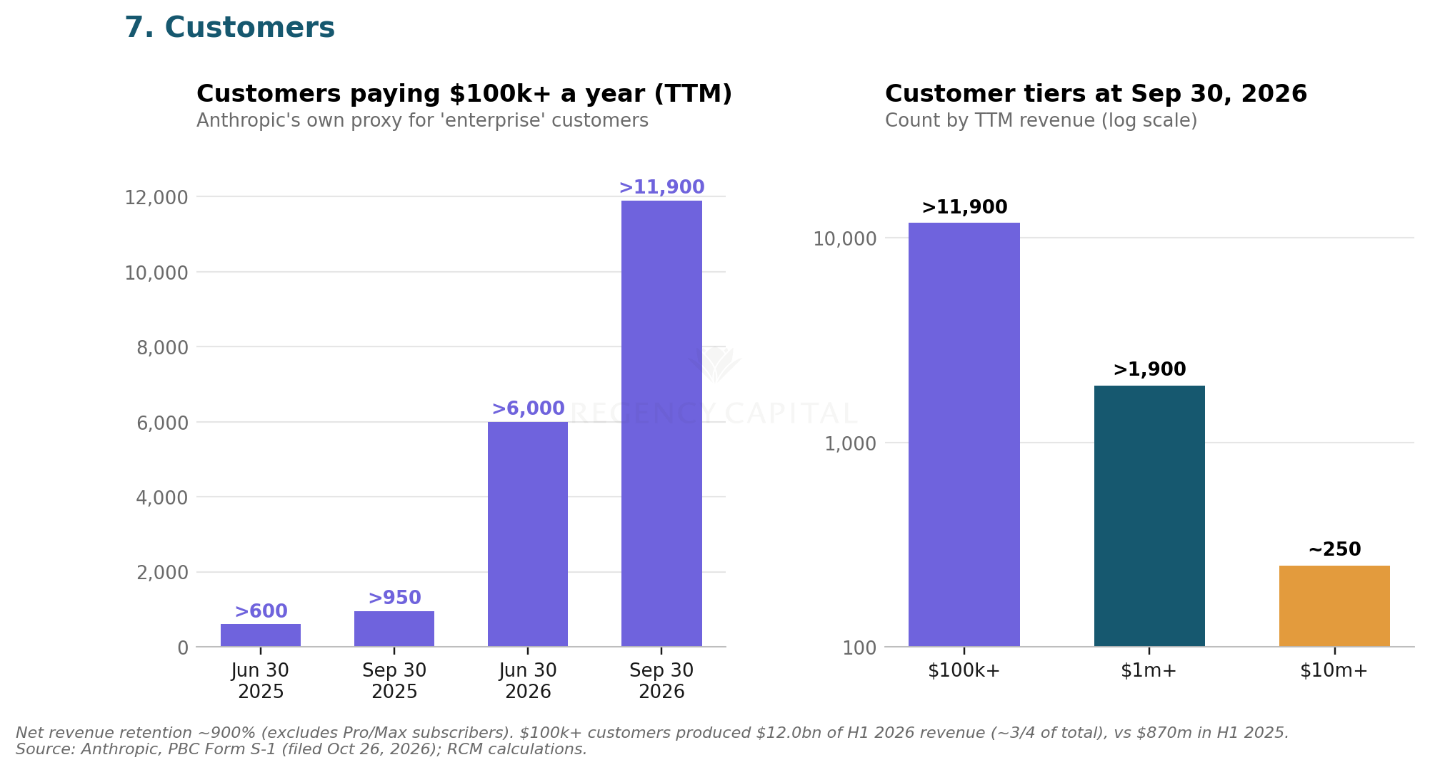
Its focus on enterprises and compliance has been a plus, in my opinion. Security and integration with other parts of the tech stack are hugely important. For many companies, Claude is the only platform passing muster right now.
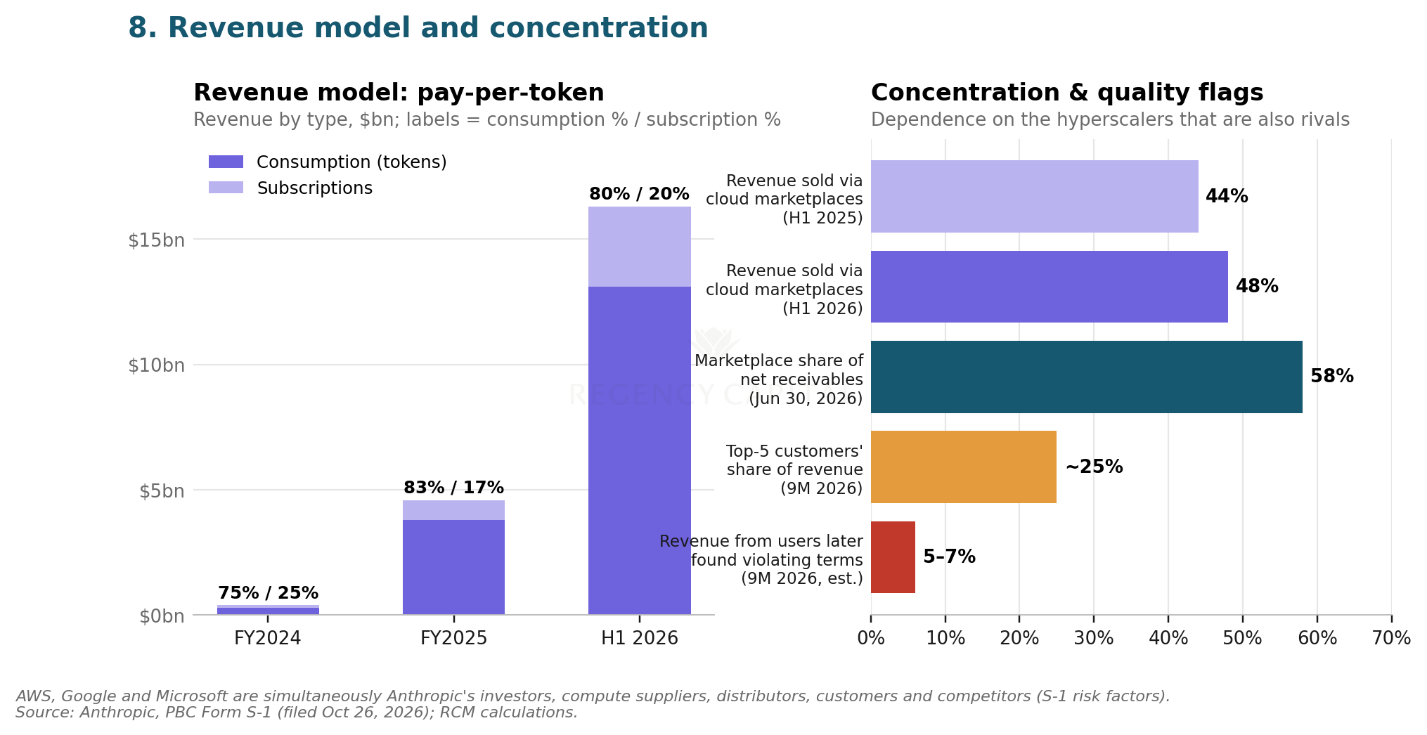
The token-based consumption and pricing model is very different from software, adding more complexity to the industry and its players.
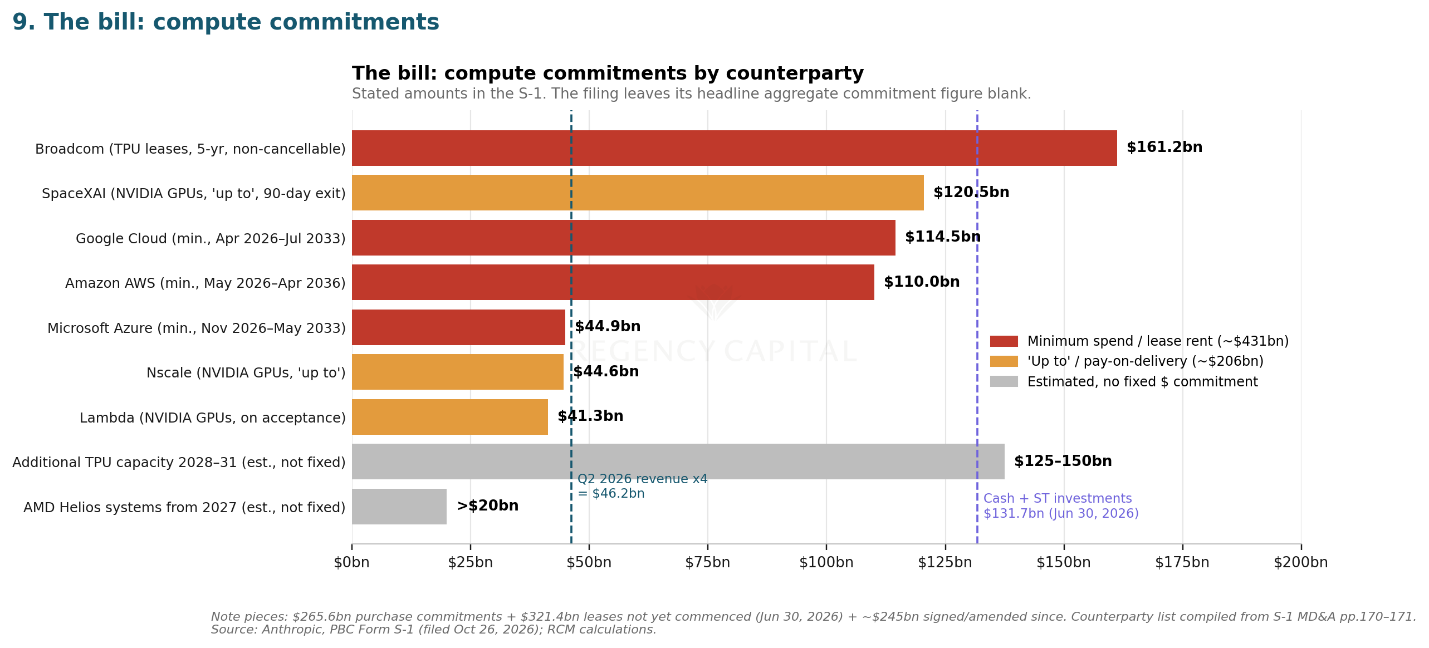
Compute is expensive and growing more so, especially for memory chips and GPUs. The ones selling picks and shovels in today’s gold rush (like Nvidia) are clearly the biggest AI winners so far.
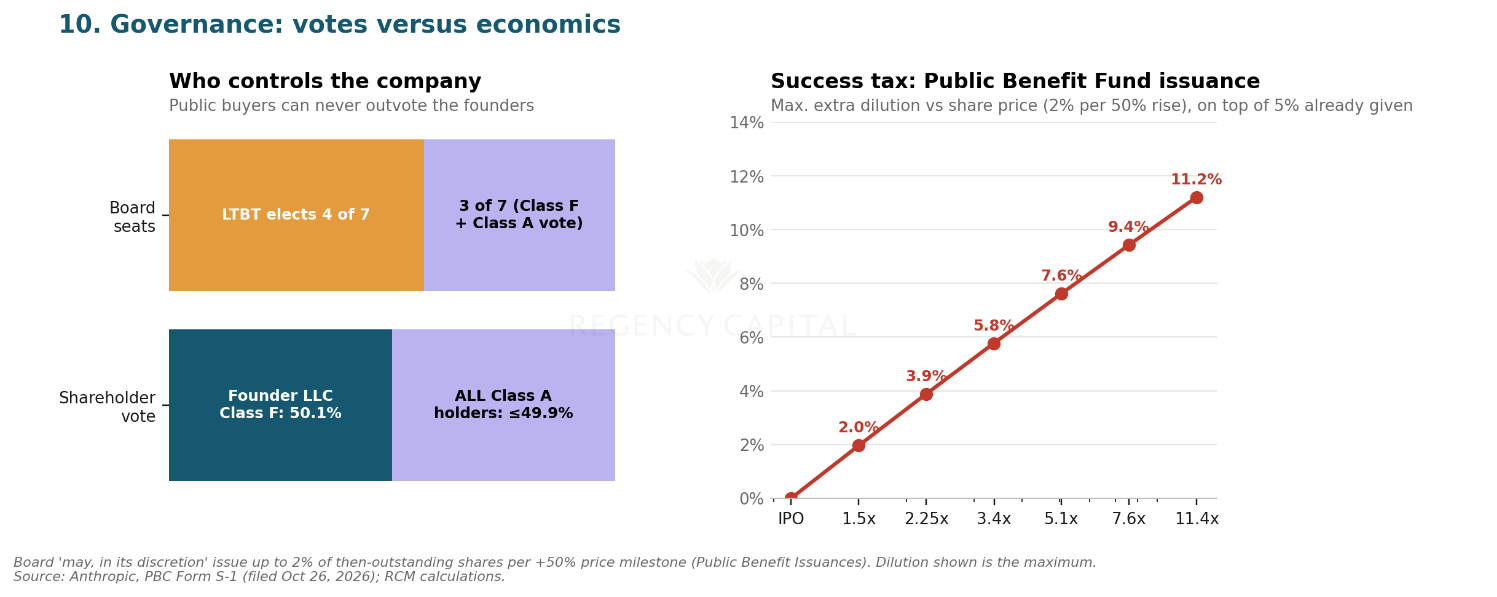
Anthropic is a public benefit corporation, not a standard corporation. That means, by law, it must consider public benefit and not just focus on shareholders. A group of people with no monetary skin in the game helps pick Anthropic’s board. We’ll see if it remains one or if it creates conflicts down the line.
Related reading: SpaceX IPO Is June 12: Initial Thoughts · China’s Real AI Advantage Isn’t the Algorithm—It’s the Electric Bill
This article is provided for informational and educational purposes only and does not constitute investment, legal, or financial advice, or a recommendation to buy or sell any security, including in any initial public offering. The views expressed are those of the author. Figures are drawn from Anthropic, PBC’s Form S-1 and press reports and are believed reliable but are not guaranteed. Regency Capital Management, Inc. is a registered investment adviser. Investing involves risk and possible loss of principal capital.
About the Author

Neil Rose, CFA, is the founder and CEO of Regency Capital Management.