
SpaceX IPO Is June 12: Initial Thoughts
By Neil Rose, CFA
Source: Wall Street Journal
The SpaceX initial public offering (IPO) will be on June 12. The initial indication is 555,555,555 shares will be sold at $135 per share under the ticker symbol SPCX. (The price and number of shares will be finalized June 11.)
At $75 billion, SpaceX will be bigger than any IPO in history—by far.
Several clients have recently asked to participate in the IPO. Here are some initial thoughts.
There’s a good chance you can get shares at the IPO price. Large IPOs are hard to participate in if you’re not a big institutional investor. That’s because in an IPO, only five to ten percent of the company’s stock is put up for sale initially. Subsequent offerings, called secondary offerings, are done over time as liquidity is needed for pre-IPO investors and/or more capital is required by the company for operations and growth.
In SpaceX’s case, a lot of liquidity is needed after numerous equity raises have been made over the years from venture capital and institutions, and thousands of employees have been hired and awarded shares as part of their compensation. The IPO will be a major payday for thousands of new official millionaires and billionaires.
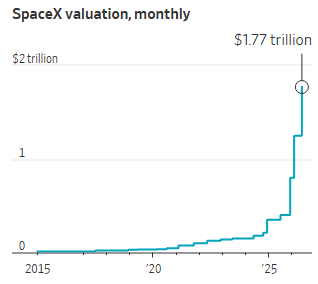
This is why SpaceX has decidedly increased the potential size of the IPO offering. At $75 billion, the IPO would be 5% of the company valued at $1.75 trillion. SpaceX said the IPO could be up to 30% of shares, a percentage I can’t recall seeing before from a large company.
Whether the IPO is ultimately $75 billion or over $200 billion, SpaceX will tap retail investors (or dump stock to them, depending on your view of the stock). The Facebook IPO comes to mind. In 2012, Facebook sold roughly 16% of the company in its IPO with most of the shares being sold by insiders and early investors. Heavy retail participation was required. The liquidity-motivated IPO (Facebook didn’t necessarily need more capital at the time) was not a fortuitous one initially: the stock was down over 50% just six months later. Of course in time, IPO buyers were rewarded—if they could bear the initial downdraft.
Something similar could happen with SpaceX buyers in the near term, especially since it seems retail will be even more important with this IPO. Brokerages have recently slashed account size requirements for IPO participation. This week one brokerage that required having $200,000 in an account for IPO participation changed to $2,000.
For SpaceX bulls, the increased access to the IPO is good news. Let us know if you’re interested in the IPO, and we can make a submission on your behalf.
SpaceX will be selling a lot more shares in the future. Typically, after an IPO, insiders’ shares are “locked up” from selling for six months after the IPO date. Among other reasons, lock ups give confidence that insiders are not just pulling a “pump and dump” on the public. So, SpaceX’s complex and aggressive lock-up policy is concerning. Insiders will be able to sell certain amounts of stock at intervals starting as early as 30 days after the IPO.
All things equal, this works against IPO investors as the market anticipates more SpaceX stock flooding markets. Ultimately, it may not matter much if the IPO is red hot. The point is, investors can always buy shares in the secondary market—like any other publicly-traded stock—after June 12, and there might be good entry points later as large chunks of new supply hit markets.
SpaceX’s valuation is ridiculous. It is. Even SpaceX bulls know this. At a $1.75 trillion valuation, SpaceX trades at 93 times sales. SpaceX still loses billions a year, and losses will accumulate for the foreseeable future. Just looking at what is right now, SpaceX is a satellite internet provider (a good and promising one) subsidizing deep space exploration, starting with colonization of Mars. How does SpaceX make money doing what is so far just a science project for humanity? No one knows. Does SpaceX ultimately get to own any of Mars or obtain specific profitable rights for its achievements? No one knows.
SpaceX is not an investment, per se, if investment means buying something at a price that’s below intrinsic value. For long term holders or short term flippers, SpaceX is a speculative bet, a gamble, or a lottery ticket. And that’s not necessarily wrong or irrational—but it is if one doesn’t admit the unknowns and absurdities in and around the stock, or too much money is bet.
Position sizing is everything; don’t be greedy. To be clear, I have no thesis on the stock or the company. For all the magnificent and unprecedented things SpaceX is doing (I will offer a SpaceX primer in the future as everyone should be familiar with the tectonic shifts Elon Musk & Co. are making), there are numerous and large risks that are magnified by the stock’s extraordinary price.
But strangely, even I don’t think putting a few bucks in the stock is necessarily foolish, especially if it primes more thinking and understanding of the massive changes underway that have huge ramifications for numerous industries and the market. Sometimes, having a little skin in the game makes for more valuable insights and actions later.
I’m considering participating in a trivial amount, though I’m averse to those bets that, if it works, it doesn’t mean I was smart, and if it doesn’t, I really was stupid. But that’s just me.
I have a lot more thoughts on this. Some points require diving deeper to do it justice. These include more macro context. IPOs for AI giants Anthropic and OpenAI are coming soon, which means history’s three largest IPOs could all happen soon. Three giant IPOs that may increase the supply of publicly traded stocks well over 5% after a long bull market…an ominous sign of a market top, no?
Buckle up. I have a feeling things are going to get very interesting.
This material is for informational and educational purposes only and reflects the personal views of the author. It does not constitute investment advice or a recommendation to buy or sell any security, including SpaceX. Investing involves risk, including possible loss of principal, and past performance is no guarantee of future results. IPO and pre-IPO investments carry heightened risk and may not be suitable for all investors. Please consult your advisor regarding your specific situation.
About the Author

Neil Rose, CFA, is the founder and CEO of Regency Capital Management.