Write more. Type less.
This is what I’m telling myself lately. It turns out there are huge benefits to going back to analog with various things. This is another kaizen in action (continuous improvement).
First, bear with me. I digress with a ranting backstory (as it turns out, I have an inner-Andy Rooney. You know what I don’t understaaaand…).
I’ve had it with being pushed at every turn to do things digitally—forced to do things digitally, usually requiring yet another new login and password I’ll immediately forget. More things every day we can’t do without going online. Schedule an appointment, making a change, even buying something right in front of you: “I’m sorry you’re going to have to register an account online. Scan this QR code.”
My kids’ school put me over the edge.
It’s enough that parents must pay to watch their kid play in a high school game after paying fees, working fundraisers, and making donations (not to mention paying taxes). You now must pay their way: scan a QR code, fill out a nosy form—one ill-designed for a mobile screen, of course—and pay a $2 processing fee along with the ticket price. And, because everyone needs to do their phone dance at the entrance, you sometimes have to wait in a long line to get in. To a high school stadium.
But that was nothing compared to the disturbing night I learned how my kids “do school.” Everything—syllabus, readings, assignments, tests, lessons, and even getting help—is done through their school-issued 150-buck Chromebook with a poor 13-inch screen.
They hunch, squint, slowly move a curser with a temperamental touch pad. They navigate a clumsy interface to go back a page, change and answer, re-read something. They must poke around when their right answer keeps coming up wrong, or there’s a glitch rendering the site—and their time—useless. Then they spend time writing an email explaining the website/portal problem to a teacher who gets a thousand emails a day, most of which require a lengthy response for compliance reasons.
Their backpacks carry no books. Rarely do they have homework in the form of loose leaf paper. When they do, my kids feel like they’ve caught a break. Homework seems almost fun in these moments.
It’s clear to just about everyone that taking digital this far has been a mistake. Kids are not learning as much. We don’t need to know that SAT scores have fallen year after year to know it’s not working. Enough time has gone for covid to keep getting the blame for all the under-performance. Anecdotally, my kids read more during the covid year than any other year, by far.
By now too many studies have been done on this subject to warrant change. Just a few examples:
- Young children tracing out their ABCs led to better recognition of letters than typing.
- Adults taking notes by hand, instead of typing, leads to better understanding of material. Typing transcribes, without cognitive processing and summarization.
- “Handwriting activates a broader network of brain regions involved in motor, sensory, and cognitive processing.” life-15-00345.pdf
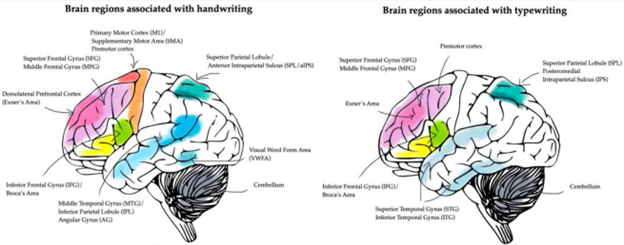
You can be sure AI is already magnifying this problem and will continue to do so. It’s like the problem with processed food in America: kids are overfed and undernourished, now intellectually, too.
Going digital this way made a lot of sense, came with a lot of benefits. Not all innovation works; it’s part of progress. The real mistake is not changing direction when it’s needed.
I’m optimistic the pendulum should swing back. The important stakeholders like families and teachers aren’t necessarily defending the way of things. They’re all frustrated.
Some states are bringing back handwriting back to schools, especially the most beneficial form, cursive.
Here’s an idea: let’s Make Analog Great Again (MAGA!). Let’s bring back books and paper and Ticonderoga pencils. And textbooks. Kids will get that added benefit of stronger legs walking miles a week with heavier backpacks.
I’ve gone to handwritten notes, memos, and first drafts. I have a paper planner and double-ring bound personal “dashboard” (The Japanese-made paper is really something!)
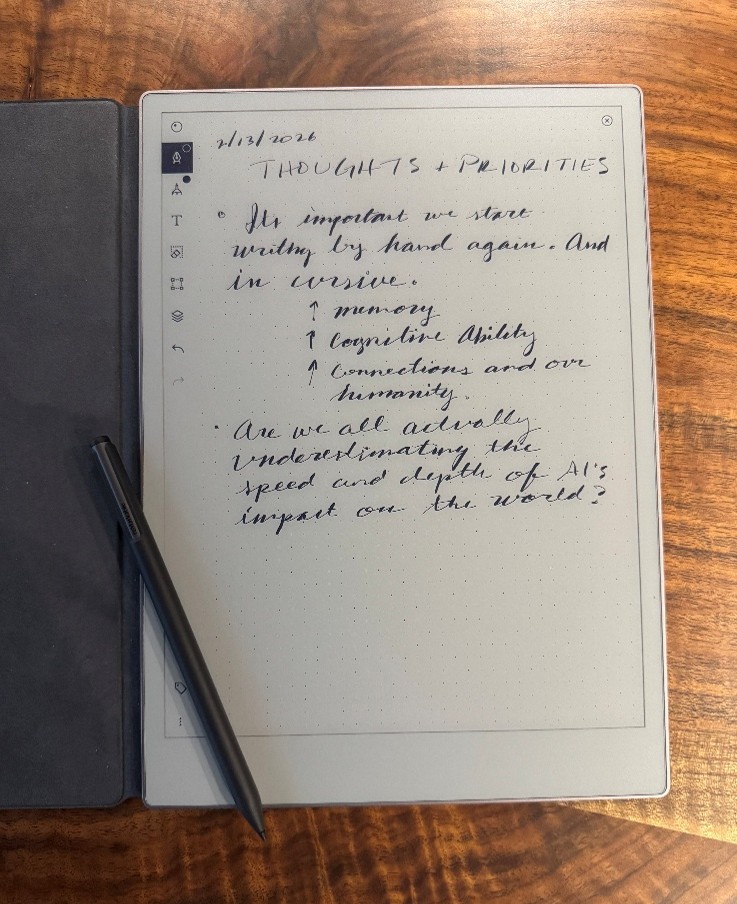
I have a reMarkable device that feels like writing on paper but on a page can then be electronically filed or emailed. It can even take my messy writing and make a version in text (takes a little editing, though). Reading PDFs and e-books and writing in them, is easy. It has been a good compromise.
And I’m using cursive as much as I can. It’s coming back slowly (it’s been maybe 35 years). It makes things slower, sure, but I’m getting more out of it. I’m already noticing differences. I’m dropping fewer balls and getting more done writing by hand, even if it’s just listing tasks in the planner, or prioritizing something in the dashboard.
There’s a certain satisfaction to crossing things off on that smooth Japanese paper, then going home a bit more present.
About the Author

Neil Rose, CFA, is the founder and CEO of Regency Capital Management.