There are advantages to thinking about bad circumstances in advance, including financial ones. We already do this in many ways. We make wills and trusts, buy insurance, save.
That’s usually where thinking about bad things stops; there’s only so much discomfort people voluntarily take. I think the advantages multiply the more time and variety of bad situations one can dress rehearse in their head. Bad markets and falling income should be included.
The ancient stoics preached the idea of practicing poverty. I did this experiment in my early twenties, depriving myself of everything I didn’t need, slashing spending and comfort. I realized I needed far less than I was consuming, and I was spending in a way that didn’t maximize happiness. The Lexus and other nice things I got because that was what a respectable professional required, so I was told.
It was all wrong. For many, a fancy car and club memberships are good spends because they sufficiently increase the their level of happiness and joy in life. But they didn’t do anything for me; I wasn’t into cars and I seldom golfed or ate at the clubs. They were poor spends for me.
Anyway, a little deprivation and discomfort unlocked some truth and made me a more efficient consumer later. Today I pay up for quality shoes, chairs, beds, eggs, and anything allowing for time savings or enhanced productivity. I splurge on books.
Almost everything else, I look to ruthlessly cut or minimize (though only marginally successful at that if I’m being honest).
Likewise, there are benefits in thinking about brutal market environments. Anticipating a stock market cut in half, interest rates falling (or rising), inflation being four percent as opposed to two percent, etc. make for easy stress testing. It’s just not necessarily fun.
Dress rehearsing misfortune can help bring clarity to short term versus long term goals and risks. Stocks are for the long term, so even a 50 percent drop in stocks should be rather immaterial to one’s financial plan—but not if the allocation to stocks is unreasonably heavy. Thinking about a severe bear market often reveals a misallocated investment strategy.
The exercise also primes opportunistic thinking and greater ability to lean against the crowd. Great investing is almost always borne in discomfort and contrarian thinking.
Like in life, investing comes with a lot of pain and setbacks to endure. They’re unavoidable. Yet, there’s treasure that comes with it, that comes because of it—so long as you avoid the catastrophic, of course.
Every year the stock market brings gloom and fear, even ones with soaring markets. At some point in time the market is down from where it was before. These intra-year declines, or drawdowns, can be rough and distressing.
Below is chart that coincidentally starts the year I was born. In 46 years, the average drawdown experienced during a calendar year was 14.2%. That average includes seven years (out of 46) experiencing a drop of 25% or more and one year when stocks were cut in half.
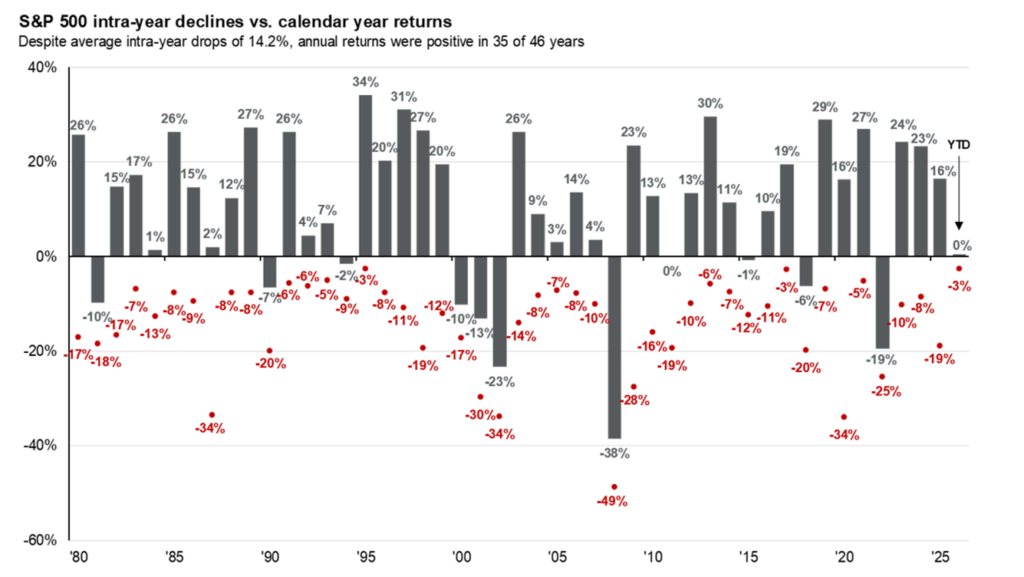
Temporary paper losses are inevitable. That’s guaranteed. However, we should be just fine. More than fine.
I mention all this because I think we might be heading for a phase of market pain, soon. It might have already begun.
We’ve taken steps, and more will come. These may not avoid losses altogether, but it should limit them, at least enough so all of us can breathe easy, or at least should breathe easy.
Seeing a souring market might not be easy. I know it isn’t for me. How we will feel then will be a function of human biology, those same quick fight-or-flight reflexes that helped humans survive over millennia but work against us today when we make financial decisions. Markets tend to punish our natural instincts.
In the uncomfortable or distressing times ahead, it helps to remember our biology is a faulty gauge for assessing risk and danger. What’s called for is something Howard Marks calls “second-order thinking” that’s the logical and quantifying part of the brain that checks the part of us that’s still the skittish hunter-gatherer, still eking it through a short and brutish life.
Second-order thinking knows the shorter term pain is the price of longer term gains. Second-order thinking is why we view all market calamities as opportunities in retrospect.
About the Author

Neil Rose, CFA, is the founder and CEO of Regency Capital Management.