It’s not often I think of the past. My brain just isn’t wired for reminiscing, which is a shame because I haven’t held onto a lot of good memories. Too many have been deleted from the hard drive. It was well into adulthood when I realized my default setting is on the future—making plans, weighing possible outcomes, or chewing on how to improve something.
This is never more apparent to me than when a friend starts with, “Do you remember when,” and I know there’s a 50/50 chance I don’t. Worse, retained memories are skewed to the negative. I don’t remember my first touchdown or graduation day, but I can remember in detail many painful moments, especially if I was at fault.
Constantly thinking about the future also comes at the expense of being present and savoring the moments worth savoring. I am painfully aware of this every time I see my teenage kids, especially my first born who will be off to college this Fall.
I confess all of this because Regency Capital Management made five years on New Year’s Day, and as much as I want to reminisce and share some of the highlights and lessons learned, it’s likely most are lost in a fogged-out landscape. For me, it’s always about tomorrow.
The Premise
Five years ago, I started a new firm, motivated by putting long-held ideas and business concepts to work, the same ones I observed in companies I invested in and admired. It seemed obvious certain principles led to better outcomes—and for all stakeholders—regardless of size or industry. Mostly, these companies were adept at something simple but essential: they didn’t get in their own way.
They seemed to practice a cornerstone philosophy of the late Cus D’Amato, the legendary boxing trainer who adopted a young Mike Tyson after Tyson’s mother died: “You don’t exist, only the task,” D’Amato would repeat to his young protégé.
How transformative that simple reframing of mindset must have been, to separate one’s ego from actions, visualize opponents as tasks to be mastered; to realize it’s not about you but the fight—the task. D’Amato turned a troubled youngster into someone humble, coachable, disciplined, and tenacious.
I wanted to be immersed in a similar mindset: task over ego, client first, empower others, decentralize decision-making, be self-critical, always improve—a place governed by the trite. “If it’s trite, it’s right,” said Charlie Munger, Warren Buffett’s philosopher-king partner and the patron saint of Regency.
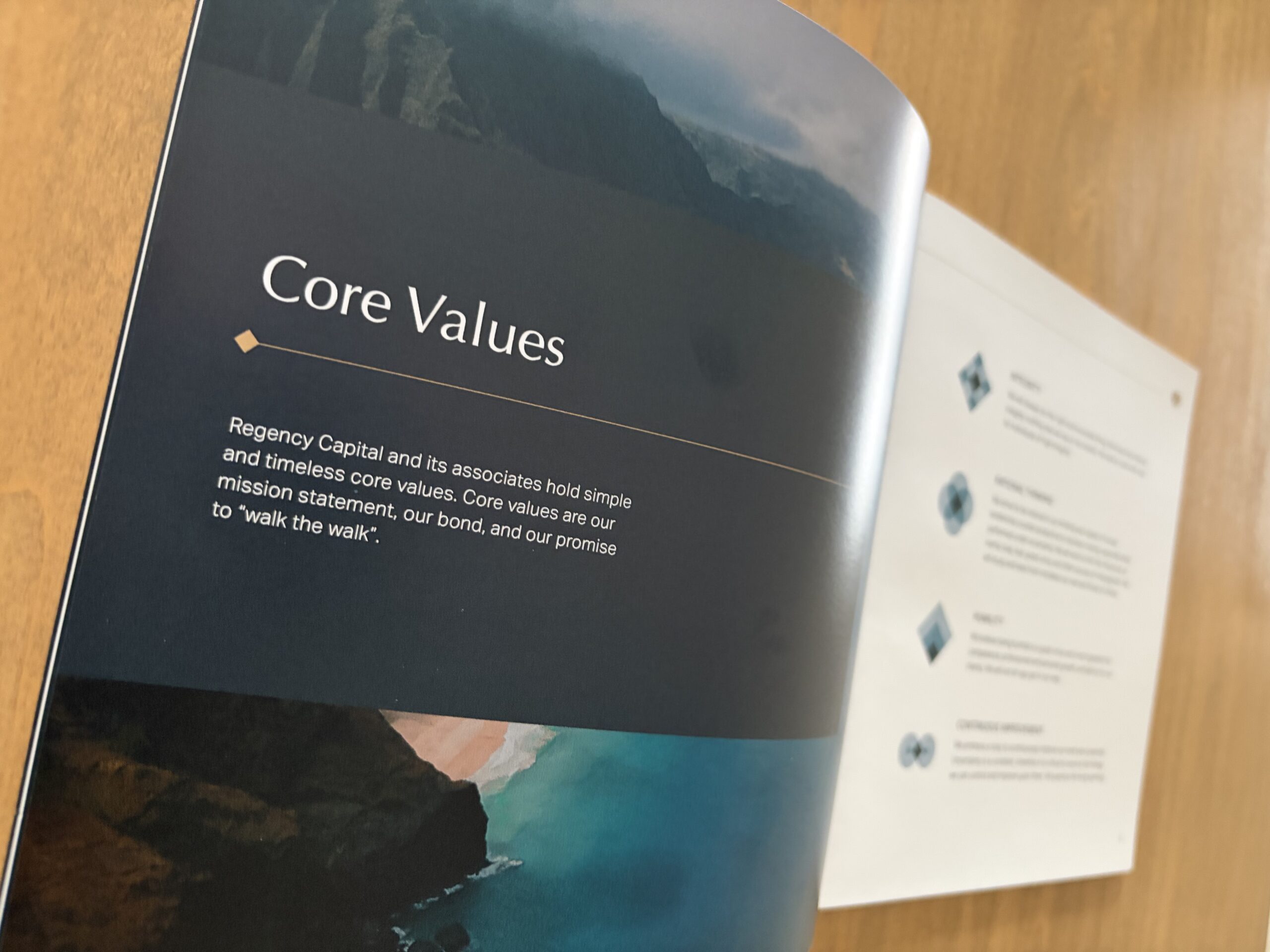
The very first thing I did for the new firm was spend a day and a half putting to paper what would be our core values. They remain our foundation and North Star. I then wrote what the firm would be about in a small booklet. In the action of the early days, I somehow forgot to mail it to Regency’s charter clients. That booklet is enclosed.
Five years in, and I still start my day thinking of these principles and values. This is not to say we have been exemplary at executing on these—far from it. After five years, I’ve found simple isn’t necessarily easy. I’m thankful that the progress we have made so far has led to outsized effects—in people, process, and performance.
The cause-effect evidence is compelling enough that I fixate on what could happen if we got 1% closer to pure alignment with principles, 10% closer. We do not exist, only the task. The things we’ll do when this becomes as natural as breathing!
In Case I Forget
It would be impossible for me to articulate the biggest lessons of the past five years. Some come to mind, and I want to write them down in case they are later deleted from the hard drive.
- Our clients are (still) our greatest asset. Obviously, serving clients is the business, but the secret sauce here has long been a wonderful clientele aligned similarly when it comes to values and money. There’s an investing edge when one doesn’t need to use differing investment lenses and can eat his own cooking. Never has a consideration of client blowback factored into any investment decision. Few managers have that advantage. Having the right clientele also allows us to harness investing’s greatest power: time.
- Having the right people is critical. Teams are not inherently an asset; they are a leveraging mechanism. The right mix of talent and character can result in parabolic progress and happiness. Having the opposite accelerates failure and dread. A permanent function of a manager is finding, building, and protecting great people, especially when almost all a business’s assets are but human capital.
- Flat team structure. For better or worse, I think a “flat” organization is better than one traditionally formal and hierarchical, especially for smaller businesses. Bureaucracy is the enemy. Communication, accountability, flexibility, productivity, and creativity are better fostered when you hire the right people and try to get out of their way. Sure, there are downsides to this approach, and I’ve probably made more mistakes as a manager and businessperson this way (I certainly get a lot more grief), but the upside in flatness is huge. It might even be table stakes as the world moves ever faster.
- We must first not be stupid. I’ve always been fascinated by mistakes, especially among businesses. Human folly is just as prevalent in the biggest corporations as they are in small business. Most are usually the result of some unforced error, where envy, greed, groupthink, ego, and/or other forms of bias lead to dysfunction and even doom. To be the best in town doesn’t require genius or perfection. We only must do things better than others, and make better progress toward our potential than others.
- I’m a lucky guy. The older I get, the more I think luck has shaped my life. From having my parents, to growing up in Hawaii, having great teachers and friends; to somehow getting opportunity after opportunity; to my wife, Lisa, whom I don’t deserve…wow. It really isn’t about me.
I am truly grateful.
The next five years won’t be as easy or smooth. I believe this. Markets won’t be as cooperative, or at least I think it’s reasonable and prudent to assume as much. However, the next five years should see better conditions for proving our mettle and worse for wanton speculation. In the very least, I’m confident we will continue to work hard, learn, improve, and refrain from doing anything completely stupid.
Time should do the rest. Thank you for your trust, confidence, and friendship over the years. It has meant the world to me.
Sincerely,
Neil Rose, CFA
About the Author

Neil Rose, CFA, is the founder and CEO of Regency Capital Management.